


Penang, Malaysia

Our tour today was with a wonderful tour company, Lawrence Blue and our guide was Norman Kee. We were met at the cruise terminal in a comfortable A/C van and taken to the UNESCO World Heritage site Georgetown where we hopped on traditional trishaw tricycles and given a ride through Chinatown and Little India. If you ever visit here, don’t let anyone tell you that the trishaws are touristy. Our entire group all agreed this was a wonderful way to see the historic Georgetown and we enjoyed the ride very much.
Eventually, we arrived to the clan house Khoo Kongsi, the largest clan house in Malaysia. Some historical perspective; the forefathers of the Khoo family who emigrated from South China built it as a clan house for members of the Khoo family in 1851. It was burnt down in 1901, allegedly struck by lightning, and the Chinese believed that it was due to its resemblance to the emperor’s palace, which provoked the gods. A scaled-down version was later built in 1902 and completed in 1906. Today, clam members live in and visit the compound, though like many such clan associations in South East Asia, Khoo Kongsi is no longer the center of important social activities and functions that it once held. The main clan house was impressive with inlays and carvings and wonderful frescoes.
Our next stop was a funicular ride to the top of Penang Hill for a view of the area and a buggy ride through the rainforest. Norman purchased fast pass tickets for the funicular and it was well worth the additional small fee. There was a terribly long line but we went straight away to the train and up the mountain we went. Penang Hill is 2733’ and we were to the top in 4.5 minutes. Once there, we had expansive views of the city below and the bay, though it was a bit smoggy today. We enjoyed a buggy ride through the rainforest with beautiful native plants and sounds.
When we returned to the lower station, our van was awaiting to take us to the Kek Lok Si Temple, the largest Buddhist temple in Malaysia and an important pilgrimage center for Buddhists from Hong Kong, the Philippines, Singapore and other parts of Southeast Asia. The entire complex of temples covers 30 acres and was built over a period from 1890 to 1930. Its architecture reflects Chinese, Thai and Burmese style and is indicative of its nod to Mahayana Buddhism, Theravada Buddhism, and traditional Chinese rituals. It was super impressive.
Our lunch was at a traditional dim sum restaurant, Lhong Tou, and we tasted steamed dim sum, veggies, fried shrimp spring rolls, sticky rice, crispy noodle soup, and fried pork with bbq bacon. Our stomach’s full, we headed back to the historic district where we visited more street art; the famous Children on a Bicycle mural. The innocence of childhood is captured beautifully in this mural.
Our final stop for the day was the Chew Jetty, another UNESCO site. Chew Jetty is one of the most famous and well-preserved clan jetties in Penang. Not unlike the clan house we saw earlier in the day, this historic waterfront settlement is home to the Chew clan, a Chinese community that built their homes on stilts over the water. The community of clan jetties came into existence gradually over a period spanning from the 1880s to the 1960s. In total, nine clan villages were built, but developments post-independence reduced their number to the current seven. After the city center was designated a World Heritage Site by UNESCO in 2008, the clan jetties became a heritage tourism destination and were saved from future destruction. Today, clan members still live in and work on the jetties.
We had a wonderful day exploring Penang with Norman. It is important to note that the walk from where tours are dropped off, back to the ship, is over 1 mile so please keep this in mind when planning.
Tomorrow: Sea Day
Recommended: Lawrence Blue Tours, https://lawrence.blue
Post Gallery

Loaded up and ready to go! Len, Lisa, Ron and Sharon.

Ready for a ride!

There's Mr. Magee!


Street art in Georgetown, Penang, Malaysia.

Street vendor in historic Georgetown.

Here comes Rose!

Temple in historic Georgetown.


Mosque in Georgetown, Penang, Malaysia.


Khoo Kongsi Clan House, Penang


Khoo Kongsi Clan House covered in nets to keep the birds away from the this historic home.

The Khoo Kongsi clan originally came from Fujian, China area.

Representative generations of the Khoo Kongsi clan.

This depicts the total size of the clan house, which spans many blocks. We visited the main house


The view was a little hazy from the top.


While on the mountain, we took a buggy ride through the rain forest and saw amazing plants.


Kek Lok Si Temple, Penang.

Inside Kek Lok Si Temple.

The buddhist God of mercy, Guanyin.

Kek Lok Si Temple, Penang.


Kek Lo Si Temple, Penang.


"Prayer" ribbons are provided at each temple.

At lunch at Lhong Tou Dim Sum, Penang.
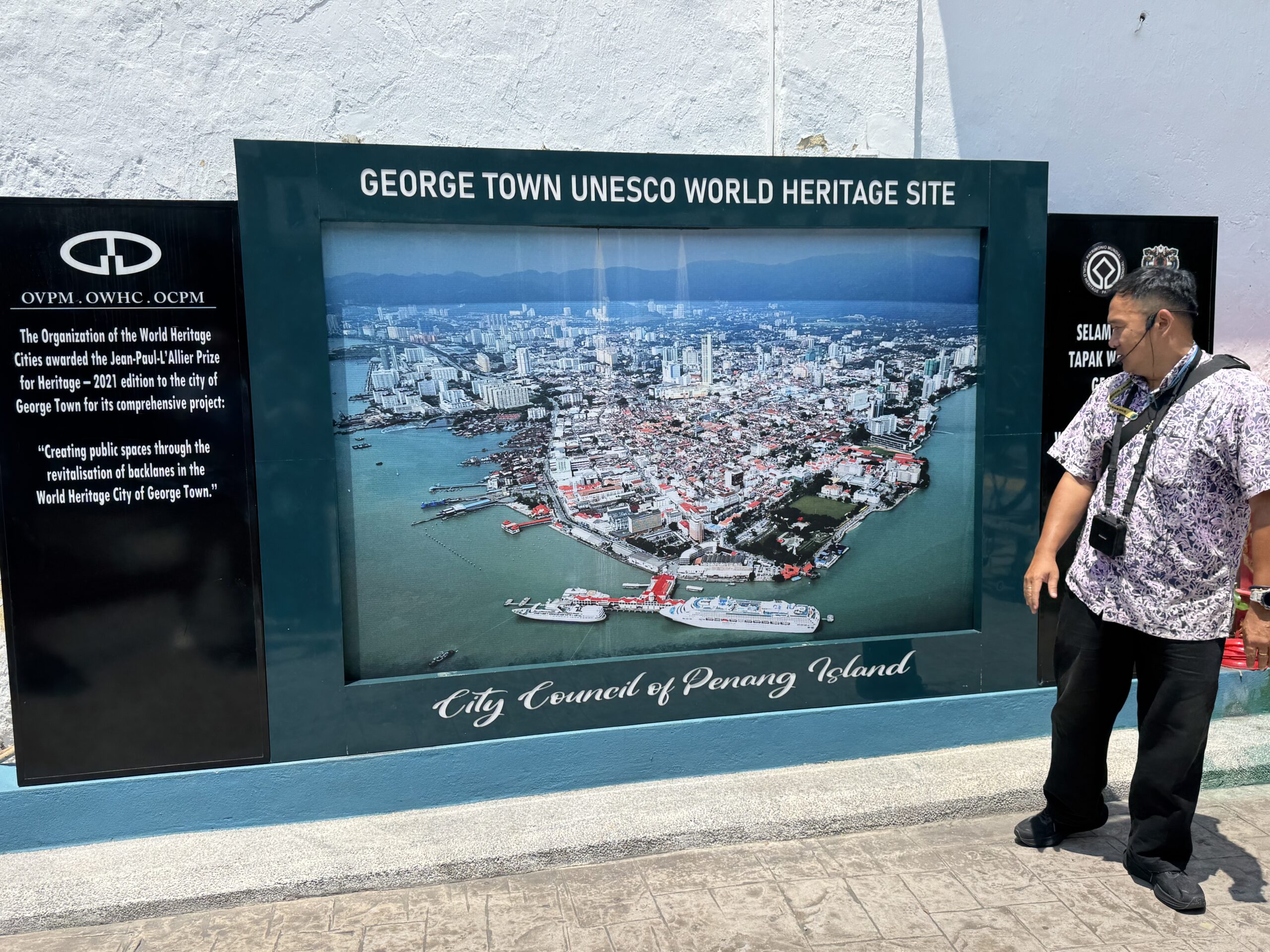
Our guide Norman Kee, with Lawrence Blue Tours.


The famous Children on a Bicycle mural, in UNESCO Georgetown.

Marsh with more street art.

Chew Jetty, Penang.

Chew Jetty, Penang.

Chew Jetty, Penang.

Chew Jetty, Penang.

Hi Sharon,
Thank you for sharing the link. I’m glad to hear you had an enjoyable tour with Norman.
This itinerary was carefully developed based on feedback from past travellers, and it differs significantly from those typically offered by large coach tours. For instance, most large group tours tend to skip highlights such as the hilltop of Kek Lok Si Temple, the trishaw ride, and the buggy ride on Penang Hill.
If you or your friends plan to visit Penang again, please feel free to get in touch. You can easily reach me at https://lawrence.blue.
I’m proud to serve yours as a guide in Penang day tour. I’m also thanks for Lawrence gave me the chance to serve yours.
I’m hope yours had a wonderful tour in Penang.
Thanks again.
What amazing history in an interesting part of the world! The temple roof lines are unique, colorful and probably very functional with the amount of rain the area receives. I love the mural of children playing and the plant decor along the jetty docks. Common color throughout most of your photos is red.
Your SE Asia trip is so reminiscent of our trip there a few years ago. We visited many of the same places and saw many of the same sites and activities. In Bali we went to an elephant reserve in the rain forest and rode one! In Borneo we hand fed orangutans. I know you will continue to have fun and wonderful adventures. Thanks for taking us along!
Very interesting ❤️